
The 7 loyalty card types in Rewardly and which plan includes each
The 7 loyalty card types in Rewardly: stamp, points, cashback, VIP, discount, gift cards and vouchers, with a table of which plan includes each one.

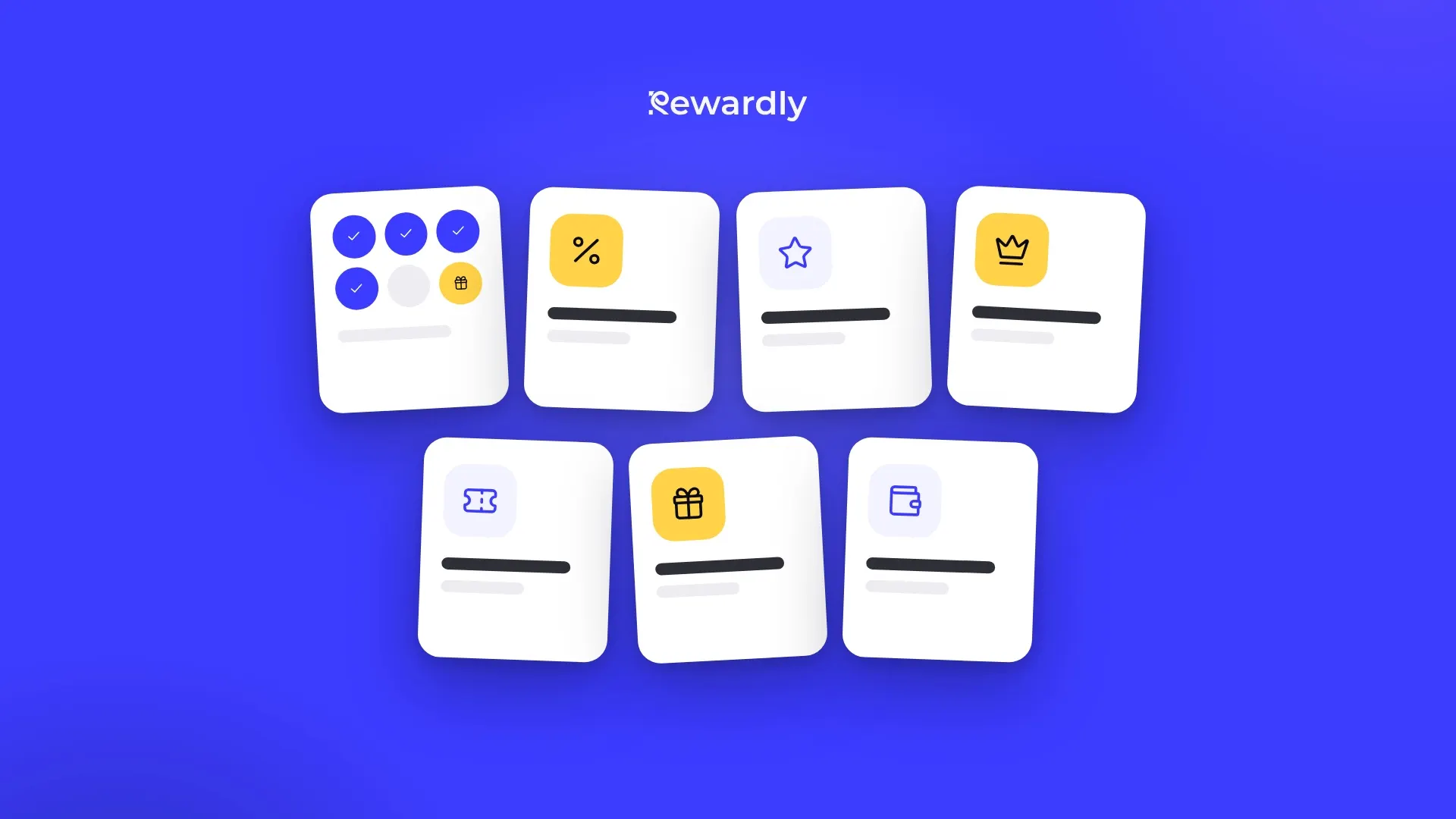
Rewardly has seven loyalty card types: stamps, points, cashback, VIP and membership, discount, gift cards and vouchers. Six of them are open on every plan, including the gift cards you give to customers as a reward. Only vouchers, which you sell online, come with the Professional plan. All seven live in Apple Wallet and Google Wallet, and you can run several at the same time.
The short answer
- Stamp, points, cashback, VIP and discount cards, and gift cards you give as a reward, are included in Basic, Advanced and Professional.
- Vouchers you sell online, in the Vouchers section, are included from Professional.
- Cards are unlimited on every plan, so a stamp card for coffee and a VIP card for your best customers can run side by side.
- What changes between plans is not the card but what you can do with it: push notifications start at Advanced, a till integration at Advanced, selling vouchers at Professional.
Loyalty card types by plan: what is in Basic, Advanced and Professional
Card type | Basic | Advanced | Professional |
|---|---|---|---|
Stamps | yes | yes | yes |
Points | yes | yes | yes |
Cashback | yes | yes | yes |
VIP and membership | yes | yes | yes |
Discount | yes | yes | yes |
Gift cards you give as a reward (the Coupon in the wizard) | yes | yes | yes |
Vouchers you sell online (Vouchers section) | no | no | yes |
You pick the type when you create a card, then design it in the card builder and set the rules. The first card takes about 2 minutes. See the plans for the full difference between them.
How to create a loyalty card in Rewardly step by step
Every card type goes through the same five steps in the dashboard, so choosing a type is the first decision, not a different tool.
- Style. Pick the card type: stamps, points, cashback, membership (the VIP card), discount or coupon, which is the gift card you give away. Vouchers you sell online are created in the separate Vouchers section.
- Design. Name the card, add your logo and banner, choose colours and, for stamp cards, the stamp style.
- Rules. Answer a few questions for the type you picked, for example how many stamps until the reward or how many points for every euro. The card updates as you answer.
- Form. Choose what customers share when they join. First name is always required. You decide which of email, last name, phone and birth date to ask for, and whether each is optional or required.
- Launch. Publish the card and share the join link or QR code. Customers open it, fill in the short form and add the card to Apple Wallet or Google Wallet.
What you set for each loyalty card type
Card type | What you set | Needs the purchase amount |
|---|---|---|
Stamps | Number of stamps, reward name, stamps per visit, optionally which products earn a stamp or can be free at the till | No |
Points | Points for every euro (1 to 50), optional weekend bonus, the rewards customers exchange points for | Yes |
Cashback | One percentage (1 to 50) or two to five levels by total spend | Yes |
VIP and membership | Visits or total spend as the measure, up to five named levels, the point where each starts, the discount of each | Spend: yes. Visits: no |
Discount | Percentage or fixed amount | No |
Gift cards you give | A value in money, points or uses that the customer spends down until it is used up | Staff redeem the value at the till |
Vouchers you sell | Fixed price, or an amount the buyer chooses within a range with up to five presets, or a pass with a number of uses | Staff enter the amount to redeem |
Stamp card: a stamp per visit or per product
The classic card. Customers collect stamps and a full card earns a reward, for example a free coffee. You choose how a stamp is earned: one per visit, whatever the customer buys, or one per product, so three coffees mean three stamps. You set the number of stamps on the card, anything from 2 to 30. With a connected till, stamps are added from the receipt. Stamp cards also support double stamp days.
It fits businesses where the same product is bought again and again: cafés, bakeries, car washes, nail salons.
Points card: points for every euro spent
Customers earn points in proportion to what they spend, from 1 to 50 points for every euro, and spend them on rewards you set. An optional weekend bonus earns points twice on Saturday and Sunday. Points depend on the purchase amount, so staff enter it in the scanner or it arrives from a connected till. Points are earned from spend, not per product.
It fits when baskets differ a lot, for example a restaurant or a shop.
Cashback card: a percentage of every purchase back as credit
A cashback card returns a percentage of each purchase as credit on the card, which customers come back to spend. You can set one flat percentage, or levels from two to five where the percentage grows as the customer spends more in total. As with points, Rewardly needs the purchase amount.
It fits shops and services where a simple "5 percent back" is easier to understand than a reward to collect.
VIP and membership card: levels with a lasting benefit
A VIP or membership card gives your best customers a lasting benefit instead of a reward to collect, for example a permanent discount. Customers move up levels, up to five, by the number of visits or by total spend, and every level has its own discount. You can also invite selected customers. See the VIP cards page. The related invitation vouchers, also called influencer cards, are on Advanced and higher.
Discount card: a standing member discount
A discount card gives members the same discount on every purchase, either a percentage or a fixed amount. It is the simplest card for a club, a team or regular clients who should simply pay less. There is nothing to collect and nothing to redeem.
Gift cards you give as a reward: a coupon on every plan
A gift card you give away is a stored value the customer holds in their wallet and spends down until it is used up. In the wizard it is called Coupon: you set what it is worth and whether it holds money, points or uses, for example "like 10 car washes". You can hand one out as a reward or a thank you. It belongs to the loyalty cards, so it is available on every plan.
Vouchers you sell online: the Professional plan
Vouchers are for selling, not for rewarding. A voucher is something a customer pays for in advance. You create it in the Vouchers section of the dashboard, part of the Professional plan.
Customers buy in your own branded voucher shop, which has its own link and can be embedded on your website. Payments go to your own Stripe Connect account, and Rewardly takes no commission on voucher sales, only Stripe's standard card fee applies. A voucher is either a gift card with a credit balance, where what is left stays on it, or a pass with a set number of uses, for example 10 coffees, and the pass in the wallet shows how many uses remain. Only one gift card can be on sale at a time. A gift card can be sent as a gift with a name, email and message, but a pass cannot be gifted. Vouchers arrive by email, ready for a wallet or as a PDF. Details are on the vouchers page.
Which plan features work on top of any card type
The card type is chosen once. What you can do around it depends on the plan.
What you want to do | From which plan |
|---|---|
Run any of the six card types you give to customers | Basic |
Scan cards with the web scanner and give staff their own logins | Basic |
Send push notifications, welcome and birthday messages | Advanced |
Show the card on the lock screen near your location | Advanced |
Add stamps and points from the receipt of a connected till | Advanced |
Segment customers and use a custom registration form | Advanced |
Sell vouchers and gift cards online | Professional |
Message a customer segment or trigger automations | Professional |
See scanner audit logs | Professional |
Default values you start from
You do not begin with an empty form. Each type starts with sensible example values that you change. A stamp card starts with 9 stamps and a free coffee as the reward, and the help text notes that most cafés choose 8 to 10. A points card starts at 1 point for every euro, a simple cashback card at 5 percent. A membership card starts with three levels that you rename and reprice. A discount card starts at 10 percent. Treat these as a starting point and set the numbers that your margins can carry.
Points or cashback? Stamps or points? Common mix ups
Stamp card or points card
A stamp card rewards a habit: the customer comes back, the card fills, the reward arrives. It is easy to explain in one sentence. A points card rewards spending: the more a customer spends, the more points, and they can choose which reward to exchange them for. Pick stamps when every visit is worth roughly the same, and points when baskets differ.
Points card or cashback card
Both depend on the amount spent. Points are exchanged for rewards you define, such as a free dessert. Cashback returns a percentage as credit that the customer spends like money. Points suit a business with a reward menu, cashback suits one that prefers a simple "5 percent back".
VIP card or discount card
A discount card gives everyone who holds it the same discount. A VIP card has levels, so the benefit grows as a customer visits or spends more, and you can also invite selected customers. If you want a flat perk for a group, such as a team or a club, take the discount card. If you want to reward loyalty over time, take the VIP card.
A gift card you give, a voucher you sell
A gift card you give is a reward, something you hand out for loyalty. It is free for the customer, lives in the loyalty cards (the Coupon in the wizard) and is part of every plan. A voucher you sell is a product the customer pays for in advance. It lives in the separate Vouchers section and needs the Professional plan. They answer different questions, and many businesses use both: a stamp card to bring regulars back and vouchers to bring new customers in.
Examples: which card type for which business
These are examples of how the choice can go. They are not customer stories and not data.
- A coffee shop with the same drink bought every morning starts with a stamp card per visit, or per product if it wants three coffees to count as three stamps.
- A restaurant where the bill ranges from a coffee to a family dinner uses a points card, with a weekend bonus to fill quiet days.
- A bakery or small shop that wants a message anyone understands uses cashback: "5 percent back on every purchase".
- A hair salon with a group of loyal clients gives them a VIP card with levels by number of visits, and each level has a bigger discount.
- A sports club or a team where members simply pay less uses a discount card.
- A spa that sells treatments as gifts uses vouchers on Professional, and a pass with a set number of uses for a block of visits. The same spa can give a loyal client a gift card as a thank you on any plan.
Can you run several loyalty cards at once?
Yes. Every plan lets you create as many cards as you need, for example a stamp card for coffee and a VIP card for your best customers. Each card has its own design and rules, and customers add each one separately. Cards of every type sit in the same Apple Wallet or Google Wallet as a customer's bank cards and boarding passes.
A checklist before you choose
- What do my customers buy, the same thing repeatedly or very different baskets?
- Do I want customers to collect something, or to simply pay less?
- Can staff enter the purchase amount, or will a connected till add it? Points and cashback need it.
- Do I want to sell value in advance? Then vouchers on Professional. Giving a gift card away is open on every plan.
- Do I want to message customers about their card? Then Advanced or higher.
Which loyalty card type should you start with?
- Regulars buy the same thing again and again: a stamp card.
- Baskets and spend differ a lot: a points card or a cashback card.
- You want a lasting perk for your best customers: a VIP card or a discount card.
- You want to sell prepaid value or visit passes: vouchers, on Professional.
- You want to give a gift card as a reward: a coupon, on every plan.
You can start with one card and add another later, since the number of cards is not limited. The steps from signup to the first scan are on the how it works page.
Frequently asked questions
How many loyalty card types does Rewardly have?
Seven: stamp cards, points cards, cashback cards, VIP and membership cards, discount cards, gift cards and vouchers.
Which plan includes stamp cards?
All of them. Stamp, points, cashback, VIP and discount cards and the gift cards you give as a reward are included in Basic, Advanced and Professional. Only vouchers you sell online need Professional.
Which plan includes gift cards and vouchers?
It depends on whether you give them or sell them. Gift cards you give to customers as a reward are part of the loyalty cards on every plan. Vouchers and gift cards you sell online, in the Vouchers section, are included from Professional, and in Enterprise.
Can I run more than one card at the same time?
Yes. Every plan lets you create as many cards as you need. Each card has its own design and rules, and customers add each one separately.
What is the difference between a stamp card and a points card?
A stamp card counts visits or products, one stamp at a time, and gives a reward when the card is full. A points card counts spend: the more a customer spends, the more points, which they exchange for rewards.
Do I need a till integration for points and cashback?
No. Staff can enter the purchase amount in the scanner. A connected till adds the amount automatically from the receipt, which saves that step.
What are invitation vouchers?
Invitation vouchers, also known as influencer cards, are a way to grow your audience. They come with Advanced and higher. They are separate from the seven card types.
How do staff redeem a voucher?
The customer shows the QR code from their wallet, email or printout. Staff scan it with the Rewardly scanner or the connected till and enter the amount. Whatever is left stays on the voucher.
Create your first loyalty card in 2 minutes. Try Rewardly for €0
No upfront payment, 14 days free.