What is a digital loyalty program? How it works and which type to choose
What a digital loyalty program is, how it works for customers and staff, and how stamps, points, cashback and VIP compare. Plain guide for small business.

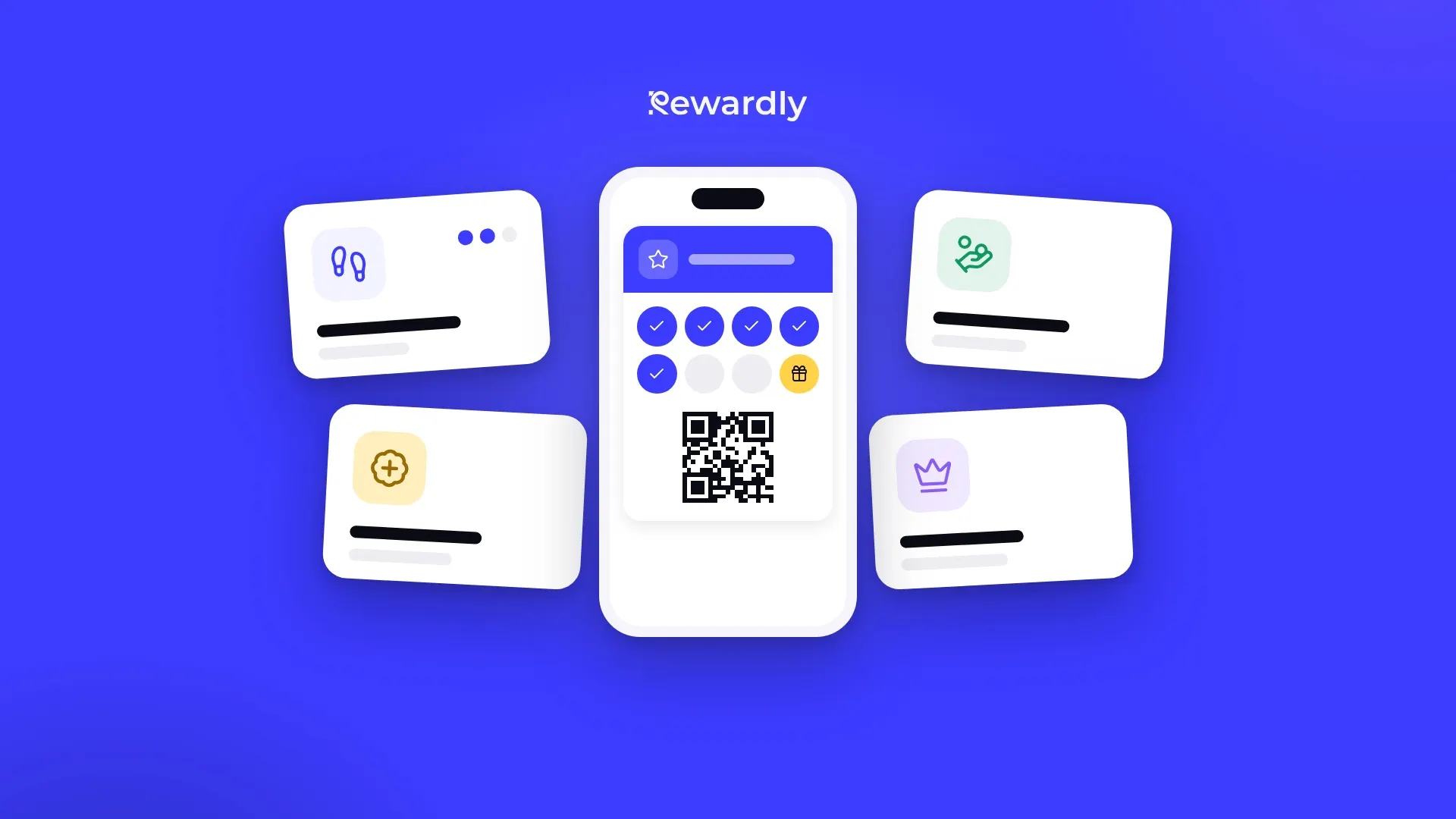
A digital loyalty program is a way of rewarding regular customers where the card, the progress and the reward live on the customer's phone instead of on paper. Each visit or purchase is recorded digitally, so you can see who comes back and reach them between visits. This guide explains how it works for the customer and for your staff, compares the main types (stamps, points, cashback and VIP), and shows what you need to start.
The short answer
With Rewardly, a digital loyalty program is a card in Apple Wallet or Google Wallet. The customer scans a QR code, adds the card in about 10 seconds and needs no app. Staff add a stamp or points at the till, and when a stamp card is full the reward is ready automatically. Start with one simple card and one reward, and add more later.
How does a digital loyalty program work?
There are three parts: the card the customer carries, the way you record a visit, and the reward.
What the customer does
- Scans a QR code on your counter, table or window, or taps a link you shared online.
- Fills in a short form. A name and an email are a good start. On Advanced and higher you choose the form fields, including a birthday, which lets you send a birthday message later.
- Adds the card to the phone's wallet. iPhones use Apple Wallet and Android phones use Google Wallet. This takes about 10 seconds and needs no app download.
- Shows the card at the next visit. After each visit the stamp or points balance appears on the card.
The card opens and can be shown without an internet connection. A new stamp appears on it once the phone is back online.
What your staff do
Staff use the Rewardly scanner, a web app included in every plan, on a phone or tablet. They scan the QR code on the customer's card and tap to add a stamp, or type the purchase amount for a points card. The phone needs an internet connection to record the visit.
If you use a connected till (Papaya POS, Storyous, Portos or Dotykačka), the purchase can be credited from the till instead. POS integrations come with the Advanced plan and higher, and the integrations page explains how each one works.
How the reward is given
When the last stamp is added, the reward is ready at once and the card starts counting again from zero, with extra stamps carried over. At the next visit staff confirm the reward in the app, or a connected till takes it off the bill. On a points card the customer spends points on a reward from your rewards list, and staff hand it over in the same step.
What types of digital loyalty program are there?
The type is the reward logic behind the card. You can run one or several, and the right one depends on how your customers buy.
Type | How customers earn | Fits best |
|---|---|---|
Stamps | One stamp per visit or per product | Cafés, bakeries, lunch places |
Points | Points for every euro spent | Shops, restaurants, salons |
Cashback | A share of each purchase returned as a balance | Businesses with varied basket sizes |
VIP or membership | Levels reached by visits or spend | Your best regulars |
Stamps
The simplest type: a stamp per visit or per product, and a reward when the card is full. Customers understand it in seconds and staff need almost no training. It works when purchases are frequent and similar in value.
Points
Customers earn points on every euro they spend, and you choose from 1 to 50 points per euro. They spend points on rewards from a list, each with its own price, so a small reward and a big one can sit side by side. Points suit businesses where a customer buys a small coffee one day and a large order the next. They come from the amount staff type in or from a connected till, never as a fixed number per visit.
Cashback
A share of each purchase is returned to the customer as a cashback balance they spend on a later visit. Without a connected till, staff type the amount spent into the Rewardly app and the balance is recalculated automatically. The reward grows with the spend, but it costs you a share of every sale, so keep the percentage modest.
VIP or membership
Customers move up levels on their own after a number of visits or an amount spent, and each level has its own discount. You can keep the card open to everyone or make it invite only. It rewards your best customers and works best as a second step, once a stamp or points card is running.
An illustration, with round numbers. A café sells a €4 coffee. On a stamp card with ten stamps, ten paid coffees earn a free one: the reward is ready after the tenth stamp and used at the next visit, so a customer who visits twice a week gets there in about five weeks. On a points card at 10 points per euro, each coffee earns 40 points and a free coffee costs 400 points, which is the same ten paid coffees. The numbers are made up for the example; yours depend on your prices and margins. See how this looks for a café.
What do you need to start?
- No app for customers. They use the wallet already on their phone.
- A phone or tablet at the counter with the Rewardly scanner, or a connected till.
- About 2 minutes to set up a first card: pick the type, add your logo and colours, write the reward.
- A QR code to print for the counter. Rewardly provides print materials for it.
- A plan. Rewardly starts from €29.90 per location per month (excluding VAT), with a 14 day free trial. A payment card is needed to start the trial, and nothing is charged until it ends.
Push messages, automatic messages (such as a welcome or birthday message) and POS integrations are part of the Advanced plan and higher. The pricing page lists every plan, and what to check for hidden fees helps you compare offers.
What can you do after customers join?
A paper card does nothing between visits. A wallet card can bring people back.
- Push messages. A message on the customer's lock screen, with no cost per message. Rewardly measures a 90% read rate on them.
- Automatic messages. A welcome message for new members and a birthday message, with text you write once.
- Your customer list. Everyone who joins appears in your dashboard, and you can export the list to CSV.
Send a message only when you have something useful to say: a new reward, a special day, a reminder that a reward is waiting.
How is it different from a paper card?
A paper card is cheap to print, but the differences add up:
- It gets lost or left at home, while the phone is always with the customer.
- You cannot see who your regulars are or how often they come.
- You cannot reach them between visits.
- Rules and rewards cannot be changed once the cards are printed.
Paper card vs digital: which one wins compares the two in detail, including cost and risks.
Does it actually work?
Businesses using Rewardly see about 30% more repeat visits, and more than 200 businesses use it. The effect comes from a reason to choose you over the place next door, plus a card on the phone that keeps you in mind.
It will not fix slow service or a weak product, and it needs a few weeks to collect members, so judge it after two or three months. To estimate what it could add for your own business, use the free loyalty program ROI calculator with your own prices and visit numbers.
What mistakes should you avoid?
- A reward that is too far away. If a regular needs six months to earn anything, they stop caring after a few weeks.
- Nobody mentions the card. A QR code on the counter that staff never point to collects very few members. Ask at the moment of payment.
- Too many rules. Start with one card and one reward, and add types after customers have adopted the first.
- Too many messages. Push messages work because they are rare and useful.
- Judging too early. One week of data tells you little.
FAQ
Is there a free digital loyalty program?
Rewardly has a 14 day free trial. The full answer on what free options exist and what a program costs is in how much a digital loyalty program costs.
Is a digital rewards program the same thing?
Yes. "Digital rewards program", "digital loyalty program" and "mobile loyalty program" describe the same idea: rewards tracked on the phone. "Digital loyalty card" names the card itself, and our guide to digital loyalty cards shows how to create one.
Can customers without Apple Wallet or Google Wallet join?
No. The card lives in Apple Wallet or Google Wallet, so a customer whose phone has neither cannot join.
Can I send text messages or WhatsApp messages from Rewardly?
No. Rewardly sends push messages to the wallet card, which appear on the lock screen like a notification. Push messages are included from the Advanced plan, with no charge per message.
See how a digital loyalty program works for your business. Try Rewardly for €0
No upfront payment, cancel anytime.